

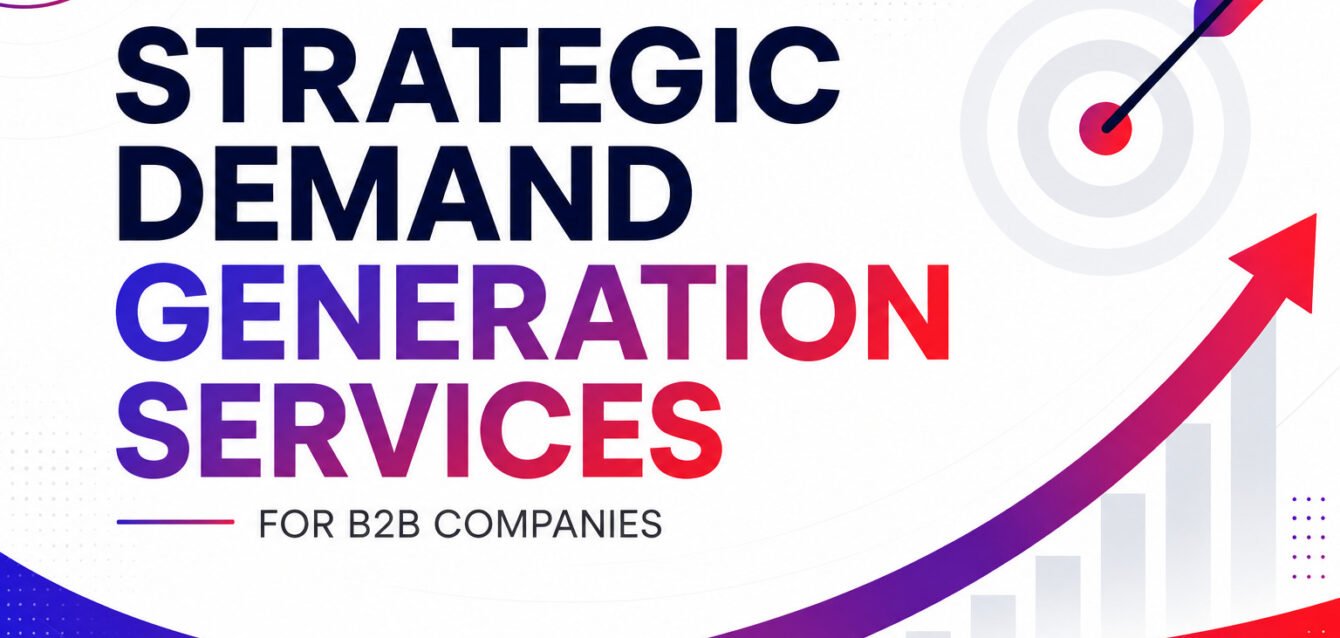
- Strategic demand generation services combine intent data, content syndication, ABM, and lead nurturing into one connected pipeline system — not isolated tactics.
- According to Forrester (2025), only 5% of your target market is actively buying at any time. Strategic demand gen captures the 5% while building trust with the other 95%.
- B2B companies using structured demand generation see up to 50% better MQL-to-SQL conversion rates compared to basic outbound programs (Demand Gen Report, 2025).
- ARS B2B Social Bridge delivers strategic demand generation services for US, UK, Canadian, and Australian B2B companies — with EST/GMT timezone overlap for real-time communication.
- The biggest mistake in demand gen: treating it as a lead capture exercise instead of a trust-building system that runs across the full buying committee.
Most B2B marketing teams are not short on leads. They are short on the right leads. Strategic demand generation services for B2B companies solve a different problem than a contact list does. They build the system that makes buyers come to you — qualified, educated, and ready to talk.
At ARS B2B Social Bridge, we have spent years working with B2B companies across the United States, United Kingdom, and Europe to build demand generation programs that actually produce pipeline. Not impressions. Not MQL volume. Actual sales conversations with decision-makers who already understand your value.
This article explains what strategic demand generation services really involve, how they differ from basic lead generation, and what a B2B company in the US or UK should expect from a properly structured program.
- What Is Strategic Demand Generation for B2B Companies?
- How Is Strategic Demand Generation Different from Lead Generation?
- What Does a Strategic Demand Generation Program Actually Include?
- How Does Multi-Channel Nurturing Fit into Demand Generation?
- Why Intent Data Is the Backbone of Strategic Demand Generation
- How to Reach the Full B2B Buying Committee — Not Just One Contact
- How Long Does It Take to See Results from Demand Generation Services?
- How Does ARS B2B Social Bridge Deliver Demand Generation?
- Frequently Asked Questions
What Is Strategic Demand Generation for B2B Companies?
Strategic demand generation is a full-funnel B2B marketing approach that builds awareness, interest, and intent among your target accounts — before they ever fill out a form. It combines content, data, and multi-channel outreach into a system designed to produce consistent pipeline, not one-off leads.
The word “strategic” matters here. A lot of agencies offer demand generation as a service. What most deliver is a list of contacts, a content syndication campaign, or a set of cold emails. That is not a strategy. That is a tactic with a big label on it.
A strategic demand generation program starts with a clearly defined ICP (Ideal Customer Profile), maps the buyer’s journey for that ICP, identifies the intent signals that indicate readiness to buy, and then builds a coordinated set of touches across multiple channels to move that buyer through the funnel. Every piece of the program — the content, the targeting, the nurture sequences, the sales handoff — is connected by data and designed to compound over time.
According to Forrester’s 2025 B2B Revenue Marketing Report, companies with a documented, connected demand generation strategy generate 208% more revenue from marketing than those running isolated campaigns. That gap exists because strategy creates compounding — each part of the program reinforces the others.
How Is Strategic Demand Generation Different from Lead Generation?
Lead generation captures contact details from buyers who already have intent. Demand generation creates that intent in the first place. Strategic demand generation does both simultaneously — building awareness among buyers not yet searching while capturing those who are actively in-market right now.
This distinction is the most important thing a B2B marketing leader needs to understand before investing in either service. Most companies confuse them and end up paying for lead gen when their real problem is a demand problem.
| Factor | Lead Generation | Strategic Demand Generation |
|---|---|---|
| Goal | Capture contact details | Build awareness + capture intent |
| Buyer stage | Already searching (5%) | Full funnel — all stages |
| Lead quality | Variable — volume-focused | High — intent-qualified |
| Timeline | Immediate results possible | 60–180 days to compound |
| Sales readiness | Often not sales-ready | Pre-educated, faster close |
| Long-term ROI | Stops when budget stops | Compounds — self-reinforcing |
The LinkedIn B2B Institute’s 95-5 rule frames this clearly: at any given time, only 5% of your addressable market is actively buying. If your entire strategy targets only that 5%, you are competing with every other vendor for a very small pool — while the other 95% buy from whoever built the strongest impression when they were not looking.
Strategic demand generation services for B2B companies invest in both sides of that equation at the same time.
What Does a Strategic Demand Generation Program Actually Include?
A properly structured B2B demand generation program includes four core layers: audience intelligence (who to target and when), content syndication (reaching them with the right asset), lead qualification (separating real buyers from noise), and nurture (keeping them engaged until they are sales-ready).
Here is what ARS B2B Social Bridge includes in a complete strategic demand generation program:
We use real-time behavioral and firmographic signals to identify accounts showing active research behavior in your category — before they contact any vendor. This is where the program starts.
Your best-performing assets — white papers, case studies, solution briefs — distributed through verified publisher networks to reach your ICP at scale. Gated for lead capture, targeted by job title, seniority, and buying intent.
Highly Qualified Leads (HQL) and Exclusive Qualified Leads (EQL) are the output of deep profiling and multi-touch verification. Every contact passed to your sales team has confirmed budget authority, need, and timeline — not just a job title match.
ARS’s proprietary nurture methodology keeps early-stage prospects engaged across email, LinkedIn, and display — using real-time signals to time each touchpoint. No spray-and-pray sequences. Every message is triggered by buyer behaviour.
Once a prospect reaches sales-readiness, ARS Connect+ books qualified, intent-verified meetings directly into your sales team’s calendar. No cold outreach from your end — only warm, pre-qualified conversations.
Every lead passed through ARS’s demand generation system is tracked in real time via postback URL — your team sees lead status updates the moment they happen, directly in your CRM or Google Sheet. Full transparency, no black box.
How Does Multi-Channel Nurturing Fit into Demand Generation?
Multi-channel nurturing is the connective tissue between awareness and conversion. It keeps buyers engaged during the 60 to 180 days between their first interaction with your brand and the moment they are ready to buy — using behavioural signals to decide which channel, message, and timing to use next.
The average B2B buying cycle in the US market involves 6 to 10 stakeholders and spans 4 to 6 months, according to Gartner’s 2025 B2B Buying Report. During that window, a buyer will typically interact with your brand 10 to 15 times before making contact.
Most B2B companies drop the ball after the first interaction. A contact downloads a white paper, gets added to an email drip, receives three generic newsletters, and goes cold. That is not nurturing. That is spam with good intentions.
ARS B2B Social Bridge’s NurtureBridge™ approach works differently. We track engagement signals — which pages a buyer visits, which emails they open, which content they download — and use those signals to trigger the next touchpoint. A buyer who reads a case study about manufacturing demand generation gets a follow-up asset specific to manufacturing. A buyer who visits the pricing page gets a personalised appointment-setting outreach within 24 hours.
This kind of signal-driven nurture is what separates a strategic demand generation program from a generic email sequence. It requires real intent data infrastructure — which is why most companies cannot build it in-house without a significant technology investment.
For more on how intent-driven B2B content works at scale, the team at IoT Insights Hub covers B2B technology adoption and content strategy in depth — useful reading for marketing leaders building their first demand gen program.
Why Intent Data Is the Backbone of Strategic Demand Generation
Intent data tells you which companies are actively researching solutions like yours right now — before they have contacted any vendor. Without it, demand generation is guesswork. With it, every dollar spent reaches an account that is already in a buying mindset.
There are two types of intent data that matter in a B2B demand generation program:
- First-party intent data — behavioural signals from your own digital properties. Page visits, content downloads, pricing page views, return visits. This is the highest-quality signal because it is specific to your brand.
- Third-party intent data — aggregate signals from across the web, tracked by platforms like Bombora or 6sense. This tells you which companies are researching topics related to your category, even when they are not on your website yet.
According to Demand Gen Report (2025), 52% of B2B marketers say intent data directly informs their content strategy, and 33% use it to prioritise prospecting. Companies using intent data in their demand generation programs report 3x better pipeline-to-close ratios compared to those relying on contact lists alone.
ARS B2B Social Bridge integrates both layers through our DataVerse™ methodology. We map intent signals at the account level, identify the buying committee within each account, and then sequence content delivery and outreach based on who is showing the strongest purchase signals at any given time.
“The best demand generation programs do not wait for buyers to raise their hand. They use intent signals to identify who is about to raise their hand — and reach them first.”
— ARS B2B Social Bridge, DataVerse™ MethodologyHow to Reach the Full B2B Buying Committee — Not Just One Contact
B2B purchases in the US enterprise market now involve an average of 9.6 stakeholders, according to Gartner 2025. A demand generation strategy that targets only one contact per account misses most of the decision-making unit. Strategic programs map and reach all relevant roles simultaneously.
This is where most lead generation programs fail at the enterprise level. A single white paper download from a marketing manager does not represent buying intent. The CFO who controls the budget, the IT director who will implement the solution, and the VP of Sales who will use it — none of them are in your CRM yet.
ARS B2B Social Bridge approaches this through what we call buying committee mapping. Before a single piece of content goes out, we identify every role involved in the purchase decision for your product, create role-specific content that speaks to each stakeholder’s specific concerns, and run parallel nurture tracks across each contact at the same target account.
| Buying Role | Primary Concern | Content Type That Works |
|---|---|---|
| VP of Marketing / CMO | Pipeline quality, brand positioning | Strategy guides, benchmark reports |
| VP of Sales / CRO | Close rates, meeting quality | Case studies, ROI calculators |
| CFO / Finance Director | Cost per lead, measurable ROI | Cost comparison tables, CPL data |
| IT Director / CTO | Integration, data security | Technical briefs, compliance docs |
| Procurement | Vendor reliability, SLAs | Company credentials, client logos |
ARS’s manufacturing and electrical industry databases — with over 12 million verified contacts across 120+ countries — allow us to identify and reach every member of a buying committee within a target account, often before the account has made initial vendor contact.
The Rise of Startups publication covers the emerging trend of buying committee-led demand gen in detail — worth reading for teams building their first multi-stakeholder demand strategy: riseofstartups.com.
How Long Does It Take to See Results from Demand Generation Services?
Most B2B companies see initial qualified pipeline movement within 60 to 90 days of a structured demand generation program. Full compounding results — where inbound and outbound align and reinforce each other — typically appear between months 4 and 6.
This timeline is longer than a cold email campaign or a paid media burst, and that is the point. Strategic demand generation builds an asset — a pipeline system — that grows in value over time. A paid ad stops the moment the budget stops. A demand generation program that has been running for six months has a full database of engaged, nurtured prospects moving through the funnel continuously.
| Timeframe | What to Expect |
|---|---|
| Days 1–30 | ICP definition, database build, content asset audit, intent baseline established |
| Days 30–60 | First content syndication wave live, initial HQL pipeline forming, nurture sequences active |
| Days 60–90 | First qualified appointments via ARS Connect+, postback tracking live, CPL data available |
| Months 4–6 | Full pipeline compounding, buyer committee coverage, MQL-to-SQL conversion improving |
| Month 6+ | Self-reinforcing system — inbound + outbound aligned, CAC declining, pipeline predictable |
Some experts argue that B2B demand generation timelines have shortened in 2026 due to better intent data platforms — and there is merit to that view. Accounts showing high-frequency intent signals can be moved to an appointment within 30 days in some cases. However, the compounding effect — where nurture database depth and topical authority both build simultaneously — still requires the 4 to 6 month window to fully activate.
For B2B companies in fast-moving sectors like IoT and industrial tech, demand generation timelines and tactics are covered in practical detail at The Business Perspective.
How Does ARS B2B Social Bridge Deliver Demand Generation?
ARS B2B Social Bridge delivers strategic demand generation services through a four-phase connected system: intent mapping (DataVerse™), content distribution and lead capture, qualification and nurturing (NurtureBridge™), and sales-ready appointment delivery (ARS Connect+) — with full postback tracking at every stage.
ARS B2B Social Bridge is a B2B demand generation agency based in Pune, India, serving clients across the United States, United Kingdom, Canada, and Australia. Our team works with US and UK timezone overlap — EST and GMT — so communication does not get lost in the gap.
We have delivered demand generation campaigns for enterprise clients including Oracle, AWS, Microsoft, and Siemens across APAC and European markets. Our verified contact database covers 88 million+ B2B professionals across 120+ countries, with 95% verification rates.
Book a 30-minute strategy call with the ARS B2B Social Bridge team. We will audit your current demand gen setup and show you exactly where the gaps are — no obligation.
Frequently Asked Questions
What are strategic demand generation services for B2B companies?
Strategic demand generation services are full-funnel B2B marketing programs that combine intent data, content syndication, lead qualification, and multi-channel nurturing to build a predictable sales pipeline. Unlike basic lead gen, the focus is on attracting the right buyers at the right time — not just collecting contact details.
How is strategic demand generation different from lead generation?
Lead generation captures contact information from buyers who already have intent. Demand generation creates that intent first. Strategic demand generation combines both — building awareness among the 95% not yet in-market while capturing the 5% who are actively searching right now.
How long does it take to see results from demand generation services?
Most B2B companies begin seeing qualified pipeline movement within 60 to 90 days. Full compounding results typically appear between months 4 and 6, according to Forrester’s 2025 B2B demand benchmark report.
Does ARS B2B Social Bridge serve clients in the US and UK?
Yes. ARS B2B Social Bridge delivers strategic demand generation services for B2B companies across the United States, United Kingdom, Canada, and Australia — with EST and GMT timezone overlap for real-time client communication.
What is included in ARS’s strategic demand generation services?
ARS B2B Social Bridge’s demand generation services include HQL and EQL lead programs, content syndication, account-based marketing, NurtureBridge™ multi-channel nurturing, ARS Connect+ appointment setting, and DataVerse™ intent data targeting — all with real-time postback tracking.
Strategic demand generation services for B2B companies are not a tactic — they are a system. ARS B2B Social Bridge builds that system around your ICP, your buying committee, and your revenue targets. If you are ready to move beyond one-off lead lists and build a pipeline that compounds over time, get in touch with our team.