A B2B lead generation strategy for a small team has one job: turn limited hours and budget into sales qualified leads. Most teams choose channels by cost per lead, then wonder why sales is unhappy.
ARS B2B Social Bridge ranked seven channels by cost per SQL instead, using 2026 benchmark medians from GrowthSpree. Customer referrals cost least per SQL in that data, at $163. SDR cold outbound cost most, at $3,222, a gap of about 20 times that cost per lead hides.
One caution up front. Every source behind this B2B lead generation strategy guide sells marketing services, so we flag limits as we go.
Pair this guide with the lead quality report
Once a channel is producing leads, judge them. The report adds benchmarks, a vendor scorecard, a 100-point scoring model and a handoff SLA.
- Benchmarks
- Scoring model
- Handoff SLA
- 30-day plan
Medians are for B2B SaaS and come from a vendor that sells marketing services. The sample is not disclosed, so read the numbers as directional.
What is a B2B lead generation strategy for a small team?
A B2B lead generation strategy for a small team is a short list of channels, chosen by cost per sales qualified lead and the hours each one needs. It names who you target, where you reach them and how you measure success. Small teams cannot run everything, so the strategy is mostly about what you leave out.
An SQL is a lead that sales has accepted as a real opportunity to pursue. An MQL is earlier: a lead that fits your profile and has engaged with your marketing. Definitions vary by company, which is why we cover the stages in our B2B lead quality report. Agree the definition before you build your B2B lead generation strategy.
The constraint is time more than money. One marketer and one salesperson cannot run SEO, LinkedIn, webinars, events and outbound at once. So the real question for your B2B lead generation strategy is which two channels to start with, and the answer should come from cost per SQL, not from habit or from whatever a competitor posted on LinkedIn.
Why does cost per SQL beat cost per lead in a B2B lead generation strategy?
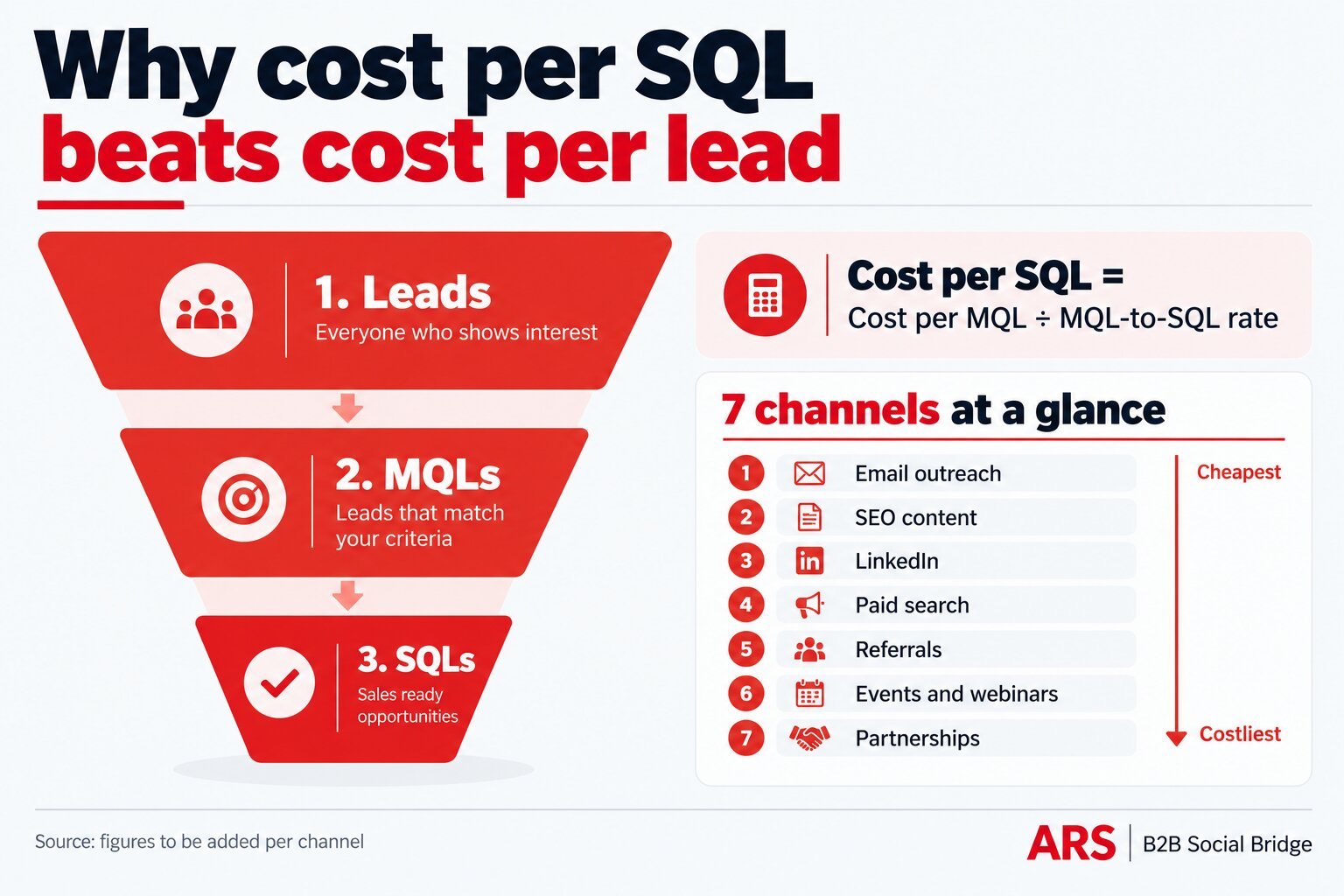
Cost per lead ignores what happens next. A B2B lead generation strategy needs cost per SQL, which divides cost per MQL by the MQL-to-SQL rate, so it prices the leads that sales actually accepts. Two channels can share one cost per lead and still differ by hundreds of dollars per SQL once conversion is counted.
The medians show why this matters. Partner referrals and Google Search Ads have the same $140 cost per lead in GrowthSpree’s data, and webinars sit close at $150. Cost per SQL then spreads out to $452, $560 and $714.
| Channel | Cost per lead | MQL-to-SQL | Cost per SQL |
|---|---|---|---|
| Partner referrals | $140 | 31% | $140 ÷ 0.31 = $452 |
| Google Search Ads | $140 | 25% | $140 ÷ 0.25 = $560 |
| Webinars | $150 | 21% | $150 ÷ 0.21 = $714 |
The reverse also happens. LinkedIn Ads aimed at named accounts cost $280 per lead, against $220 for broad LinkedIn targeting. Yet the account-based version is cheaper per SQL, at $1,037 against $1,100, because 27% of its leads convert instead of 20%.
Which B2B lead generation channels cost the least per SQL?
In GrowthSpree’s 2026 B2B SaaS medians, customer referrals cost least per SQL at $163, then content and SEO at $315, partner referrals at $452 and Google Search Ads at $560. Webinars, account-based LinkedIn Ads and SDR cold outbound follow at $714, $1,037 and $3,222. Treat the order as a shortlist for your B2B lead generation strategy.
| Channel | Median cost per lead | MQL-to-SQL | Cost per SQL |
|---|---|---|---|
| 1Customer referrals | $65 | 40% | $163 |
| 2Content marketing / SEO | $85 | 27% | $315 |
| 3Partner referrals | $140 | 31% | $452 |
| 4Google Search Ads | $140 | 25% | $560 |
| 5Webinars | $150 | 21% | $714 |
| 6LinkedIn Ads (account-based) | $280 | 27% | $1,037 |
| 7SDR cold outbound | $580 | 18% | $3,222 |
Source: GrowthSpree, B2B SaaS CPL benchmarks 2026, published 30 May 2026. We recalculated each cost per SQL from cost per lead divided by the MQL-to-SQL rate, and every figure matches within rounding. Vendor source
Median cost per SQL, cheapest to costliest
Bar length is proportional to cost per SQL. Customer referrals are about 5% of the longest bar.
A few things sit outside the seven. In-person events came in at $3,095 per SQL (a $650 cost per lead and a 21% rate), so they belong near the bottom for most small teams. Performance Max showed a $190 cost per lead but no conversion rate.
GrowthSpree reported no email-specific figures at all. None of this changes the core of a B2B lead generation strategy for a small team.
Teams weighing LinkedIn campaigns aimed at named accounts can start with IoT Mail Bridge’s account-based marketing guide, which explains how to tier a target account list. That is the discipline that makes the account-based version cheaper per SQL.
Can you trust these B2B lead generation channel rankings?
Use them with care. Each source sells services near the channels it measures, and none discloses its sample. Rankings also differ by source: SaaS Hero puts SEO’s MQL-to-SQL rate at 51%, while GrowthSpree reports 27%. Use the order to shortlist channels, then verify cost per SQL on your own pipeline.
| Source | What it sells | What it reports | Limits |
|---|---|---|---|
| GrowthSpree | Paid media, ABM, RevOps and SEO services | Median cost per lead, MQL-to-SQL and cost per SQL for nine channels | Sample and method not disclosed |
| SaaS Hero | B2B performance marketing agency | MQL-to-SQL of 51% for SEO leads against 26% for paid search | No method or source given for those two rows |
| AxZ Lead | Lead generation and appointment-setting agency | Cost per MQL: cold email $50, Google Ads $110, LinkedIn Ads $160, SEO $45, webinars $75, trade shows $500, referrals $25 (averages) | No SQL rates by channel. “Thousands of campaigns”, method not described |
The AxZ Lead figures are a useful warning. Cold email shows a $50 average cost per MQL there, a fraction of the $580 median cost per lead GrowthSpree reports for SDR cold outbound. The two define their channels and costs differently, and AxZ gives no SQL rates, so its cost per lead tells you little about cost per SQL.
GrowthSpree’s own page has quirks too. Its headline cost ranges for Google Search Ads and SDR outbound do not match its channel table. That is one more reason to treat these as medians to test, not targets to hit.
In the interest of full disclosure, ARS B2B Social Bridge is also a lead generation business, so we may favour a B2B lead generation strategy built on qualified leads. We have tried to keep our view separate from the sourced numbers.
How should a small team pick its first two channels?
Pick one slow-build channel and one fast-capture channel for your B2B lead generation strategy, then judge both on cost per SQL. A common pairing is content and SEO with customer or partner referrals. Add SDR cold outbound later, once cheaper channels are running. This pairing is ARS reasoning, not a published rule.
| Channel | Cost-per-SQL rank | Team hours | Speed to first SQL | Watch-out |
|---|---|---|---|---|
| Customer referrals | 1 | Low | Medium | Volume depends on your customer base |
| Content marketing / SEO | 2 | Medium | Slow | Compounds, but takes months to build |
| Partner referrals | 3 | Medium | Medium | Needs partners who already reach your buyers |
| Google Search Ads | 4 | Low | Fast | Captures demand that already exists |
| Webinars | 5 | Medium | Medium | Prep and promotion take real hours |
| LinkedIn Ads (account-based) | 6 | Medium | Fast | Needs a tight target account list |
| SDR cold outbound | 7 | High | Medium | Needs a person, data and compliance checks |
The rank column comes from the GrowthSpree medians. The hours, speed and watch-out columns are the ARS B2B Social Bridge judgement from running programmes, so adjust them to your own market. ARS reasoning
Lowest-cost pair
Customer referrals plus content and SEO. Best when you have happy customers and can wait for search traffic to build.
Fastest start
Google Search Ads plus partner referrals. Best when you need pipeline this quarter and some budget to spend.
Account-focused pair
Account-based LinkedIn Ads plus webinars. Best when you sell to a short list of named accounts.
Add later
SDR cold outbound and in-person events. Both cost far more per SQL in this data, so add them once cheaper channels run.
If you choose outbound, read the rules before you send. Email, call and lead-sharing consent differ in each country, and our B2B email compliance atlas maps ten markets.
How do you measure and test your B2B lead generation strategy?
Track four numbers by channel: cost per MQL, MQL-to-SQL rate, cost per SQL and SQL-to-customer rate. Run each channel for 30 days against a pass mark written in advance. Compare with your own baseline, not a benchmark. Then cut the weakest channel and keep the best.
The Business Perspective lists the same building blocks, including customer acquisition cost and the MQL-to-SQL ratio, in its guide to growth marketing funnel metrics. Set them up in your CRM first, so every lead in your B2B lead generation strategy carries its source.
- Week 1: Set the baseline. Agree one SQL definition with sales. Record cost per MQL and MQL-to-SQL for each channel you already use.
- Week 2: Write the pass mark. Pick a cost per SQL you can afford and note it down before any results come in.
- Week 3: Run and tag. Tag every lead with its channel. Check consent rules before any outbound message.
- Week 4: Read out. Compare each channel with the pass mark. Keep the best, fix the middle and stop the worst.
This test is ARS reasoning. We found no independently sourced pass mark for a B2B lead generation strategy, so yours should come from your own numbers.
What do critics say about ranking channels by cost per SQL?
Critics say cost per SQL stops too early. It ignores deal size, win rate and how long the cycle runs, and SQL definitions differ between companies. They also note that cheap channels have ceilings. All fair points, which is why a B2B lead generation strategy should use the ranking to shortlist channels and not to pick a winner.
A cheaper SQL is not always a cheaper customer. SDR cold outbound is the costliest channel here, but we have no data on deal size by channel, so we cannot say it is a bad buy for large deals.
Volume is another limit. Customer referrals top the ranking, but they cannot be bought on demand, so most small teams will need a second channel to grow.
Timing matters as well. 6sense’s 2025 study found 94% of buying groups ranked preferred vendors before first contact, so channels that work early, such as content and referrals, may get less credit than they deserve in last-touch reporting. And, as Prospeo notes, benchmark studies define MQL, SAL and SQL differently, so check definitions before comparing.
Last, every number here is for B2B SaaS and comes from vendors. Services, manufacturing and other sectors may rank channels differently.
What do marketers ask most about B2B lead generation strategy?
What is the best B2B lead generation strategy for a small team?
Start with two channels, not seven: one slow-build channel such as content and SEO, and one fast-capture channel such as referrals or Google Search Ads. Judge both on cost per SQL. In GrowthSpree's 2026 medians, those channels sit in the cheaper half. Treat that pairing as ARS reasoning and test it on your own pipeline.
How do you calculate cost per SQL?
Divide cost per MQL by the MQL-to-SQL rate. In GrowthSpree's data, Google Search Ads show a $140 median cost per lead and a 25% MQL-to-SQL rate, so cost per SQL is $140 divided by 0.25, or $560. Use your own spend and your own SQL definition before comparing channels in your B2B lead generation strategy.
Which B2B lead generation channel has the lowest cost per SQL?
Customer referrals, in GrowthSpree's 2026 B2B SaaS medians: $163 per SQL, from a $65 cost per lead and a 40% MQL-to-SQL rate. Content and SEO follow at $315. GrowthSpree sells marketing services and does not disclose its sample, so use the ranking to shortlist channels, not to set targets.
Is SDR cold outbound worth it for a small team?
It is the costliest channel in GrowthSpree's data, at a $3,222 median cost per SQL against $163 to $1,037 for the other six. That does not make it wrong, since deal size matters too. A small team should add it later, once cheaper channels are running, and check email and call rules by country first.
What is a good MQL-to-SQL rate for B2B?
It depends on the channel and on how you define each stage. GrowthSpree's channel medians run from 18% for SDR cold outbound to 40% for customer referrals. SaaS Hero reports 51% for SEO leads and 26% for paid search. Compare your rate with your own history before any industry average.
How long should you test a B2B lead generation channel?
We suggest at least 30 days per channel, with a pass mark for cost per SQL written down before you start. A B2B lead generation strategy with SEO in it may need longer to show results, so judge them on leading signs as well. This is ARS guidance, not a published standard.
What should you do next about your B2B lead generation strategy?
Work out cost per SQL for the channels you use today, then pick one slow-build and one fast-capture channel to test for 30 days. Write the pass mark first, tag every lead by source and add costlier channels later. Download the lead quality report to score what comes in.
A good B2B lead generation strategy is mostly subtraction. Rank your options by cost per SQL, start with two channels and let your own data overrule any benchmark, including ours. Revisit your B2B lead generation strategy every quarter as costs and conversion move.
For wider business and marketing analysis, read The Business Perspective. For technology and automation coverage, see IoT Mail Bridge and IoT Insights Hub. ARS B2B Social Bridge, a B2B lead generation partner for demand teams, publishes more research at arsb2bsocialbridge.com.
Download the free B2B Lead Quality Report 2026 from ARS B2B Social Bridge. Benchmarks, scorecard, scoring model, SLA and 30-day plan in one 26-page PDF.
Download the free PDF