Every B2B lead generation company sounds great on the first call. The case studies are polished, the dashboard is slick and the price per lead looks fair. The differences hide in five answers the vendor hopes you will not ask for.
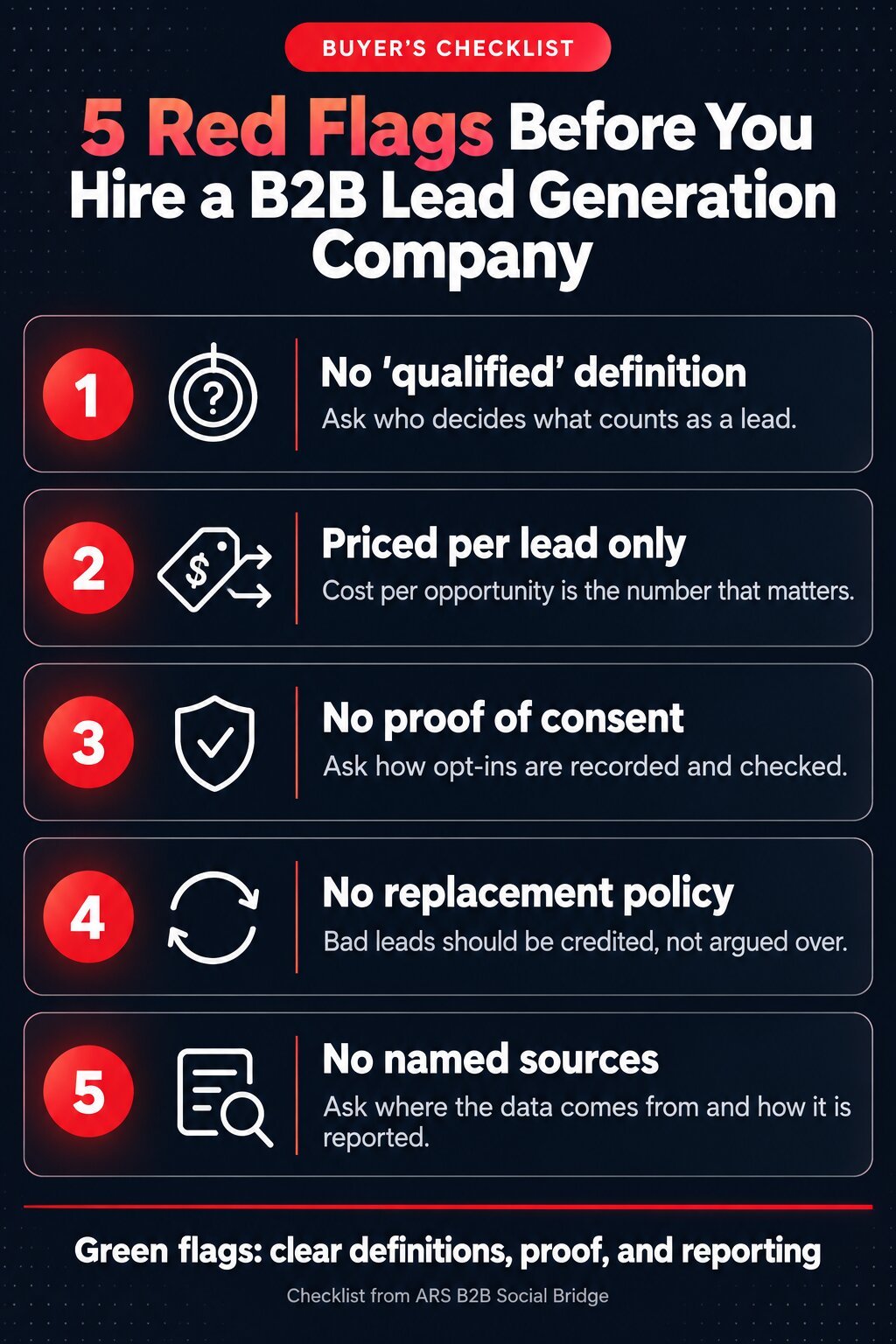
This guide from ARS B2B Social Bridge turns those answers into five red flags, a scorecard and a pitch decoder you can use on your next call. It draws on named benchmarks from Marketing Week, Foundry, Prospeo and the UK regulator, the ICO. Try the 60-second test first: ask your current vendor to put its definition of a qualified lead in writing. How fast and how clearly they answer tells you most of what you need.
Figures come from Marketing Week, Foundry, First Page Sage (reported by Prospeo) and the UK Information Commissioner's Office. Several benchmarks come from vendor and agency publications, so read them as directional.
What does a B2B lead generation company actually sell?
A B2B lead generation company sells contact details of people who match your buyer profile, often with some qualification layered on top. Models include content syndication, appointment setting and intent data. The price per lead looks simple, but what counts as a lead, and how it was collected, varies widely between vendors.
Most B2B lead generation company offers fall into three models: syndicated content downloads, outbound appointment setting and intent-based lists. Foundry CRO puts syndicated leads at $40 to $100 each, against an average B2B lead cost of about $237 across all channels. Sotros Infotech quotes $25 to $80 for basic contact-level MQLs and $150 to $400 for intent-qualified, BANT-verified leads.
That spread explains why shopping on price alone goes wrong. Two vendors can both say "qualified lead" and mean very different things. Teams buying for technical audiences can see how decision-makers consume gated research on IoT Insights Hub.
The pressure to buy is real. Marketing Week's State of B2B Marketing survey of 600 marketers found that 40.2% feel pressure to deliver marketing qualified leads regardless of quality. When volume targets lead the brief, red flags are easy to miss. At ARS B2B Social Bridge, we start from the opposite end: what a sales team can use.
Red flag 1: Does your B2B lead generation company define a qualified lead in writing?
If a B2B lead generation company cannot give you a written definition of a qualified lead, you are buying a word, not a standard. Marketers themselves disagree on what an MQL is. A signed definition, with job titles, company size, intent signals and exclusions, is the first thing to ask for.
Red flag 1: No written definition of "qualified"
Foundry ran a LinkedIn poll of 130+ marketers asking how they define an MQL. 37% said a demo request or hand-raise, 30% said an activity such as a download, 22% said an intent score and 11% said something else. Foundry noted the poll was informal, but the split makes the point.
Revnew adds that vendors apply different standards for what counts as a qualifying engagement. A vendor that counts any download as a lead will always deliver more leads than one that counts only a demo request. Neither is wrong, but only one matches your sales process.
The fix is simple. Ask for the definition as a one-page appendix to the contract: target titles, industries, company size, the action that triggers delivery and a list of exclusions. ARS B2B Social Bridge builds this into its Qualified Buyer Framework so both sides agree before the first lead ships.
Red flag 2: Why does price per lead mislead when you pick a B2B lead generation company?
Price per lead hides how many leads you need to create one sales opportunity. A cheap lead that converts rarely can cost more per opportunity than an expensive one that converts often. Ask every B2B lead generation company for cost per opportunity, using cost per lead times leads per opportunity times one plus the bounce rate.
Prospeo's formula is the cleanest way to see through the invoice: cost per lead x leads per opportunity x (1 + bounce rate) = true cost per opportunity. Revnew warns that tracking only leads delivered and cost per lead hides the real story. Implisit research published by Salesforce found that across channels only 13% of leads become opportunities, and the average conversion takes 84 days.
The table below shows why the cheapest quote is not always the cheapest outcome. The figures are illustrative, so swap in your own data.
| Vendor | Cost per lead | Leads per opportunity | Bounce rate | True cost per opportunity |
|---|---|---|---|---|
| Vendor A (cheaper lead) | $40 | 8 | 10% | $352 |
| Vendor B (pricier lead) | $90 | 3 | 4% | $281 |
In this example, Vendor A looks 55% cheaper per lead and ends up more expensive per opportunity. Founders watching runway can compare this logic with The Business Perspective's guide to raising seed funding for startups, where every dollar of spend has to earn its place.
Red flag 3: Can your B2B lead generation company prove consent for every lead?
A promise of consent is not proof of consent. The UK ICO has said buyers must check how and when consent was obtained, by whom, and what the person was told. A B2B lead generation company that cannot show a consent record per lead is passing its legal risk to you.
The ICO's enforcement history is blunt on this point. It fined The Data Supply Company £20,000 after over 580,000 contact records were sold on, and it said: "Data controllers buying in lists must check how and when consent was obtained, by whom, and what the customer was told." It added: "It is not acceptable to rely on assurances of indirect consent without undertaking proper due diligence."
A second case shows the cost of trusting another company's word. The ICO fined credit broker Digitonomy £120,000 over more than 5.2 million marketing texts. Head of enforcement Steve Eckersley said: "Depending on the word of another company is simply not acceptable and is not an excuse."
Both cases date from 2017 and involve UK consumer messaging, and rules differ by country and by channel. The principle travels well, though: the business that runs the campaign is responsible for the data it uses. This is not legal advice, so check with your counsel.
In practice, ask for the opt-in wording, the date, the source page and the named parties covered. ARS B2B Social Bridge sets out how it handles personal data in its EU GDPR policy.
Red flag 4: What happens when your B2B lead generation company delivers bad leads?
Every B2B lead generation company delivers some bounced emails, wrong numbers or duplicates, so the contract must say what happens next. Look for a rejection window long enough to test the data, clear reasons for rejection and a credit or replacement within days. Silence on this point is a red flag.
Prospeo's playbook says to shift the KPI to cost per opportunity and to enforce lead-rejection policies for bounces and disconnected numbers. That only works if your contract has a rejection window and your team checks inside it. A vendor who says "we never get complaints" has often just made complaints hard to file.
Data also ages quickly. IndustrySelect, citing MarketingSherpa, puts B2B contact data decay at about 2.1% a month, or roughly 22.5% a year. Treat that as a directional figure, but it explains why a list bought in January can be stale by summer.
Ask four things: how many days you have to reject a lead, what counts as a valid reason, whether you get a credit or a replacement, and how long a replacement takes. ARS B2B Social Bridge built a postback system for lead status updates, so buyers can report on each lead without chasing email threads.
Red flag 5: Does your B2B lead generation company name its data sources and report openly?
A trustworthy B2B lead generation company tells you where leads come from, how they were validated and what each campaign delivered. Madison Logic's CEO told Demand Gen Report that syndication providers have long operated like a black box. If a vendor will not name sources or share reporting, assume you cannot audit the results.
Madison Logic CEO Keith Turco told Demand Gen Report in October 2024 that providers have historically offered little visibility into content placement, and that marketers should demand more. We agree. Transparency is not a bonus feature, because without it you cannot tell a strong campaign from a weak one.
Digital Nexa advises asking how a partner validates leads, including duplicate removal, email verification and job-title checks. Ask to see a sample batch before you commit, with the source asset or channel named for each row.
Reporting should go beyond leads delivered. Ask for results by campaign, by asset and by source, plus the status of each lead after your team works it. Lean teams like those covered by Rise of Startups benefit most, because they cannot afford to find out in month three that a channel never worked.
How do you score a B2B lead generation company against the five red flags?
Give each vendor 0, 1 or 2 points per red flag: 0 for no answer, 1 for a partial answer and 2 for a written, specific answer. A total of 9 or 10 earns a shortlist spot, 6 to 8 means negotiate, and 5 or below means walk away. This scorecard is our own tool, not an industry standard.
Use the scorecard on every vendor call, and keep the sheet. Comparing three vendors on the same five questions shows differences that polished decks hide.
| # | Red flag | 0 points | 1 point | 2 points |
|---|---|---|---|---|
| 1 | Lead definition | No answer | Verbal only | Written and specific |
| 2 | True price | Per-lead price only | Shares conversion rates | Quotes cost per opportunity |
| 3 | Consent proof | Assurance only | Policy page | Record per lead |
| 4 | Replacement terms | None | Vague window | Clear window and credit |
| 5 | Sources and reporting | Black box | Totals only | Named sources, campaign reports |
The pitch decoder
Sales pitches use friendly phrases for risky answers. This decoder translates five common lines and gives you the follow-up question for each.
| The pitch says | It can mean | Ask this |
|---|---|---|
| "All leads are qualified." | Anyone who downloaded something | What is your written definition? |
| "Our price per lead is the lowest." | Low conversion is not shown | What is your cost per opportunity? |
| "We are fully compliant." | A policy page, not records | Can I see consent records for a sample? |
| "We rarely get complaints." | Complaints are hard to file | How many days do I have to reject leads? |
| "Our data is proprietary." | Sources are not disclosed | Which sources feed my campaign? |
Can a cheap B2B lead generation company still be the right choice?
Sometimes, yes. A low-cost B2B lead generation company can suit awareness goals, high-volume products or teams with strong nurture programs. The red flags are about transparency, not price. A cheap vendor that defines leads, proves consent and offers replacements can beat an expensive one that does none of these.
Critics of red-flag lists have a fair point: checklists can make buyers too cautious. Foundry CRO puts in-person events at roughly $811 per lead, so a $40 to $100 syndicated lead can still be a bargain when the audience fits. Sotros Infotech argues that syndication needs an average contract value of about $15,000 for positive ROI once nurture and SDR time are counted.
Our view at ARS B2B Social Bridge: low price is fine, and low transparency is not. If the vendor answers all five questions in writing, the price becomes a negotiation, not a warning sign. If it cannot answer even two, no discount makes up for it.
What do B2B buyers ask most about choosing a lead generation company?
Buyers mostly ask what vendors do, what they charge, how to check consent and how to judge results. The six answers below use named benchmarks. Many come from vendor and agency studies, so treat them as directional and test any figure against your own CRM data before you plan a budget.
What does a B2B lead generation company do?
A B2B lead generation company finds and delivers contacts who match your buyer profile, using models such as content syndication, appointment setting or intent data. Some add qualification and nurture. Because definitions differ, ask each vendor for a written lead definition and a sample batch before you sign.
How much does a B2B lead generation company charge per lead?
Foundry CRO puts syndicated leads at $40 to $100 each, and Sotros Infotech quotes $25 to $80 for basic MQLs and $150 to $400 for intent-qualified leads. Price rises with targeting, so compare vendors on cost per opportunity, not on the headline price per lead.
How do you check a B2B lead generation company is GDPR compliant?
Ask for proof, not promises. The UK ICO says buyers must check how and when consent was obtained, by whom, and what the person was told. Request the opt-in wording, date and source for each lead, and ask your legal counsel to review the vendor's terms.
What is a good MQL-to-SQL rate to expect?
Prospeo, citing First Page Sage data, reports an average MQL-to-SQL rate of 13% for B2B SaaS, 15% for cybersecurity and 11% for fintech. Your rate depends on lead definition and follow-up speed, so compare vendors against your own history, not only against industry averages.
Should I choose a lead generation company by price per lead?
No. Price per lead hides conversion. Prospeo's formula multiplies cost per lead by leads per opportunity and by one plus the bounce rate. A cheaper lead that converts poorly can cost more per opportunity, so ask each vendor for conversion history and rejection terms.
What should a lead generation contract include?
Include a written lead definition, proof of consent, a rejection and replacement window, named data sources and campaign-level reporting. Add who reviews rejected leads and how fast credits arrive. These five terms answer the red flags in this guide and make results easy to audit later.
What should you do before you shortlist a B2B lead generation company?
Before you shortlist a B2B lead generation company, collect five written answers: a lead definition, a cost-per-opportunity quote, consent proof, replacement terms and named sources. Score each vendor out of 10 on the scorecard. Any vendor below 6 has already told you how the relationship will go.
- A written definition of a qualified lead, signed by both sides.
- Cost per opportunity, not only cost per lead, in every quote.
- A consent record per lead: wording, date, source and named parties.
- A rejection-and-replacement window long enough to test the data.
- Named sources and campaign-level reporting, with a sample batch first.
A good B2B lead generation company welcomes these questions, because clear answers win deals. ARS B2B Social Bridge builds its programs on that standard, and you can see how in the Growth Qualified Lead (GQL) framework and the ARS DataVerse methodology.
Want leads that pass all five checks? See how ARS B2B Social Bridge screens buyers before delivery.
See the Qualified Buyer Framework