Picture a Monday pipeline meeting. Marketing reports 400 MQLs against a target of 350, and sales accepted barely 120. Two people looked at the same number and reached opposite conclusions, which is the whole argument about B2B lead qualification in one scene. (The numbers are an illustration, not a client case.)
ARS B2B Social Bridge read the published research from Forrester, 6sense, the Pedowitz Group and Workato, and combined it with our own qualification methods. This guide explains why B2B lead qualification breaks down and sets out a three-test standard you can apply this month. The free whitepaper below goes deeper.
One caution up front. Several sources here sell related products, so we label each one, and ARS B2B Social Bridge sells B2B lead generation services too. Treat our methods as a proposal to test, not an industry standard.
Download the full B2B lead qualification whitepaper
The Verified Buyer Standard, BANT, the DualSignal sequence, a hand-over brief, a KPI scorecard, a 30-day rollout and a 12-point self-assessment. Share it with the sales leader you want on your side.
- Verified Buyer Standard
- BANT
- Scorecard
- 30-day plan
Forrester is an analyst firm. 6sense and Workato sell related software, so read their figures as directional, not as audited benchmarks.
What is B2B lead qualification, and why does it fail?
B2B lead qualification is the process of deciding which leads are ready for a sales conversation. It checks that the company fits, the buying signals are real, and a person has confirmed need, budget, authority and timing. Without that check, a form fill gets treated as a buyer.
Most teams use three labels for the same funnel, and they mean different things. An MQL says “I am interested”. An SQL says “I am ready”. ARS B2B Social Bridge adds a third label, the Growth Qualified Lead, for a contact who fits, shows intent and has been checked by a person.
| MQL | SQL | GQL (ARS) | |
|---|---|---|---|
| What it says | “I am interested.” | “I am ready.” | “I fit, I show intent, and a person checked.” |
| What was done | Downloaded a guide or clicked an email | Genuine purchase intent confirmed | Fit, intent and a human check together |
| Budget and authority | Not confirmed | Both confirmed | Fit and interest checked by a person |
| Owner | Marketing | Sales | Shared handover |
Definitions from the ARS B2B Social Bridge Qualified Buyer Framework and Growth Qualified Lead pages. ARS reasoning
B2B lead qualification fails when the word “qualified” means a click to marketing and a conversation to sales. Nobody lied. The two teams never agreed on one definition.
Why do sales teams reject so many MQLs?
Sales teams reject MQLs when the score measures marketing activity while sales judges fit, authority and timing. The Pedowitz Group suggests a well-calibrated model earns 65 to 75% sales acceptance, and below 50% means sales sees the leads as unqualified. Those ranges are guidance, not measured data.
Acceptance rate is the share of MQLs that sales agrees to work. It is the cleanest test of B2B lead qualification, because it shows whether both teams mean the same thing by “qualified”.
| Acceptance rate | What it suggests |
|---|---|
| Below 50% | The model is sending sales leads they see as unqualified. |
| 65% to 75% | Typical for a well-calibrated scoring model. |
| Above 80% | The threshold may be too conservative, so good leads are held back. |
Source: The Pedowitz Group, a revenue marketing consultancy (2026). These are the author’s guide ranges, and no sample is disclosed. Consultancy source
Pedowitz also lists why sales distrusts scoring. Sales was not part of the design, so the model reflects marketing’s idea of qualified. It counts activity while sales judges fit, authority and timing. High scores that never convert erode trust until reps stop opening the queue.
None of that is a flaw in the MQL as a concept. All of it can be fixed. Our guide on why sales ignores marketing leads walks through five hidden causes, and the B2B lead qualification benchmarks and scorecard in our lead quality report let you test your own numbers.
What are the three gaps behind poor B2B lead qualification?
The three gaps are one person standing in for a buying group, a signal that arrives after the shortlist is set, and slow follow-up. Forrester, 6sense and Workato each describe one of them. Fixing B2B lead qualification means closing all three together, not just tuning the score.
Gap 1: one person is not a buying group
Lead scoring usually tracks one person’s activity. A single person who downloads three assets looks the same on paper as three people from one company who each do one thing. The second case is far more interesting, because it looks like a buying group forming.
Forrester analyst Simon Daniels, in a November 2023 post, says matching a single deal to a single MQL “makes no sense”. He cites Forrester research showing 46% of B2B buyers in a buying group of two to three people and 28% in a group of four to nine. He also reports that clients who gave sales three or more buying group members saw a 50% rise in meeting-to-closed-won conversion. That last figure is client feedback, not a published study. Analyst research
Gap 2: the signal arrives late
6sense’s 2025 B2B Buyer Experience Study, with nearly 4,000 responses, found that 94% of buyers ranked their shortlisted vendors by preference before contacting any vendor. By the time someone fills in your form, much of the decision may already be formed, which makes B2B lead qualification at the form stage a late check. 6sense sells buyer-intent software, so keep that interest in mind. Vendor source
If you are weighing intent signals, our guide to B2B intent data explains why a surge is not the same as a buyer.
Gap 3: follow-up is slow
Workato submitted a demo request to 114 B2B companies and timed the replies. Vendor source
| Measure | Result |
|---|---|
| Did not reply within 5 minutes | More than 99% |
| Average email response | 11 hours 54 minutes |
| Average phone response | 14 hours 29 minutes |
Source: Workato. Workato sells lead-routing tools, so read the figures as directional. The study date is not stated.
Speed is a qualification problem too. A fast reply to a lead nobody has checked only reaches the wrong person sooner, so B2B lead qualification and follow-up speed have to be fixed together.
What is the Verified Buyer Standard for B2B lead qualification?
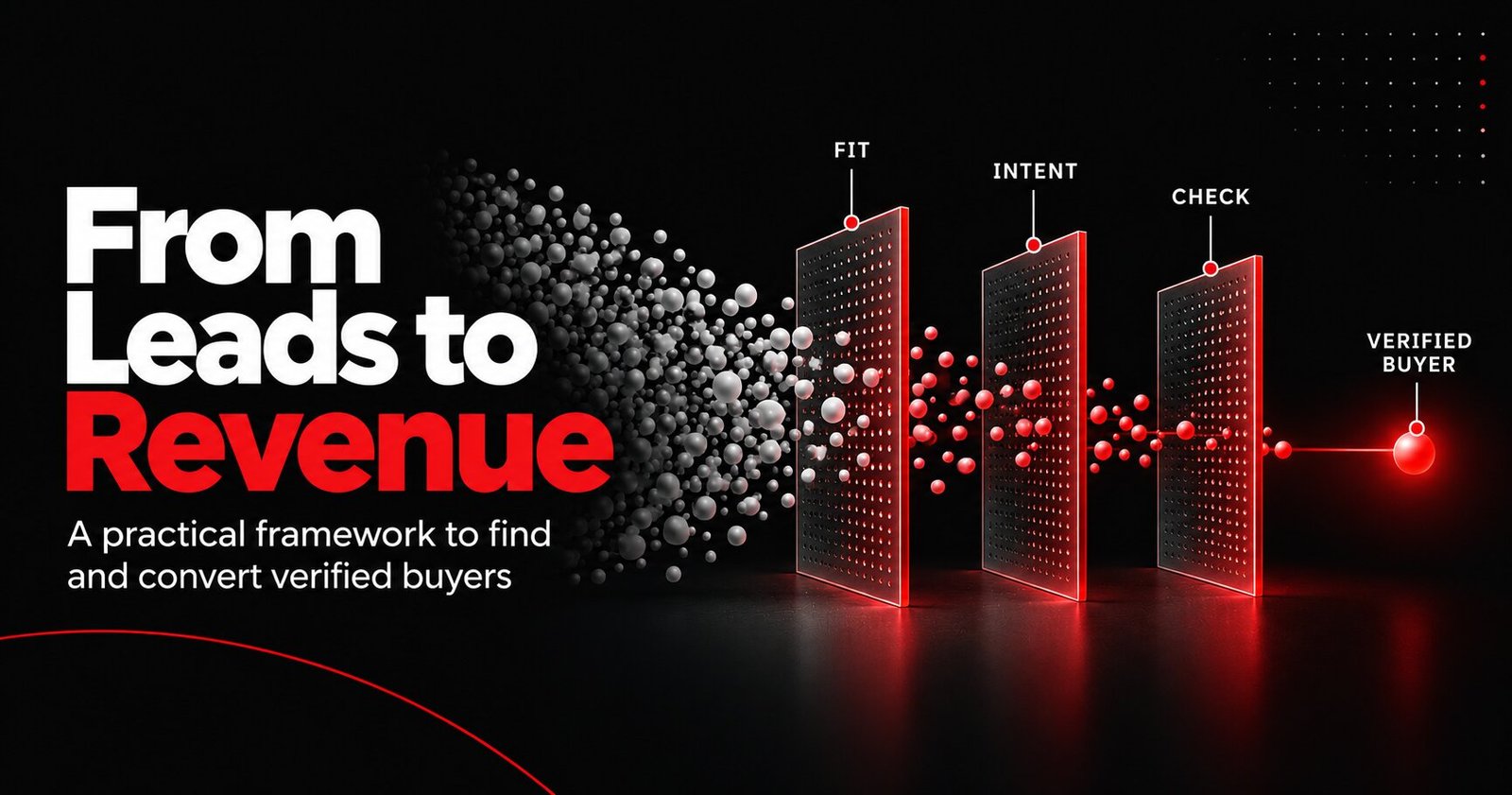
The Verified Buyer Standard is an ARS B2B Social Bridge test with three parts. A lead must fit your ideal customer, show real buying intent, and pass a human check on budget, authority, need and timeline. Fail any part and the lead returns to nurture instead of going to sales.
| Test | The question | It fails when |
|---|---|---|
| Fit | Could this company and person actually buy? | Personal email, no company, wrong size or role |
| Intent | Is anything telling us they are looking now? | One old download, one open, no pattern |
| Human check | Did a person confirm the project is real? | Nobody spoke to them, or any one of the four BANT items is missing |
The Verified Buyer Standard combines three ARS B2B Social Bridge methods. It is not an industry standard. ARS reasoning
The rule that makes it work is simple: no check, no handover. A lead that has not passed all three stays with marketing and keeps nurturing. That one rule changes what counts as a lead, and it is why sales starts trusting the number again.
The three methods behind it are the Growth Qualified Lead (fit, intent and a human check), the Qualified Buyer Framework (BANT confirmed before handover) and DualSignal (email first, then a real call). Used together, they make B2B lead qualification repeatable.
How does BANT confirm a qualified buyer?
BANT confirms four facts in a real conversation: budget, authority, need and timeline. The Qualified Buyer Framework from ARS B2B Social Bridge passes a lead to sales only when all four are confirmed. If any one is missing, the lead returns to nurture and keeps warming.
| Confirm | The question | What we look for |
|---|---|---|
| Budget | Does the company have the financial capacity to invest in a solution like yours? | No signed purchase order is needed. The money exists and a purchase is realistic. |
| Authority | Can this person make, or meaningfully influence, the decision? | Time spent on someone who cannot say yes is time sales cannot get back. |
| Need | Is there a genuine, active business problem your solution addresses? | A current pain point, not a future consideration. |
| Timeline | When do they plan to decide? | “Sometime next year” is still an MQL. “We are reviewing solutions this quarter” is an SQL. |
Source: ARS B2B Social Bridge, Qualified Buyer Framework page (October 2026). ARS method
For B2B lead qualification, the path has four steps. The Qualified Buyer Framework tracks real-time signals, scores and prioritises leads against thresholds agreed with you, qualifies in a real conversation, then hands over with a brief or returns the lead to nurture.
The brief matters as much as the call. A good one gives the rep the company background, the stated challenge, the BANT status, the engagement history and a recommended entry point, so nobody starts from zero.
Why does a human check beat email alone?
An email open or click shows interest, not readiness. DualSignal pairs a targeted email with a follow-up call from a real person, so a human confirms the project before the lead reaches your CRM. ARS B2B Social Bridge says this closes the gap where emails get opened and nothing happens.
| Email alone | DualSignal | |
|---|---|---|
| Touchpoints | One: an email | Two: an email, then a call |
| Opened but silent | Usually nothing happens | A real person follows up to book the meeting |
| Interest confirmed by | An open or a click | A human conversation |
| What reaches your CRM | A name and an email status | A lead checked by a person, with call notes |
Source: ARS B2B Social Bridge, DualSignal page (October 2026). ARS method
The second touch is a help-and-verify call, not a sales pitch. It confirms the right person, a real and active project, the need in their own words and the timeline. We do not sell appointments at ARS B2B Social Bridge. We sell qualified conversations.
Outreach of this kind has to follow the rules of each country, including honest subject lines, a postal address and a one-click unsubscribe. Our B2B email compliance atlas maps email rules across ten countries, and none of this is legal advice.
Automation can support B2B lead qualification without replacing the human check. IoT Mail Bridge’s guide to AI-powered automation tools shows how lead scoring and follow-up emails work inside a CRM.
How do you test your B2B lead qualification in 10 minutes?
Pull 90 days of MQLs and check three numbers: the share sales accepted, the median time to first contact, and how many accounts had two or more people engaged. Acceptance below half points to a definition problem. Fast contact and 65 to 75% acceptance point to healthy B2B lead qualification.
- Share accepted by sales. Divide accepted MQLs by all MQLs. Compare the result with the Pedowitz guide ranges above.
- Median time to first contact. Use CRM timestamps, not the team’s estimate. Compare it with the Workato averages.
- Multi-contact accounts. Count accounts where two or more people engaged. This shows how much of your pipeline looks like a buying group.
| What you see | What it suggests |
|---|---|
| Acceptance below 50%, first contact in days, few multi-contact accounts | Your MQL is not dead. It is not doing the job it was meant to do. |
| Acceptance near 65% to 75%, first contact within hours | You are in better shape than most teams. Tune the weights monthly. |
The reading guide is ARS B2B Social Bridge judgement, using the published ranges above. ARS reasoning
Then agree the definition of a qualified lead with sales, in writing, on one page. The Starr Conspiracy, a B2B marketing agency, says teams that define qualified leads together often stop arguing about lead quality within one to two quarters. That is the agency’s own observation with no sample given, so treat it as a signal.
Finally, share the target. When marketing and sales own the same pipeline number, review the MQL-to-SQL ratio together. The Business Perspective’s guide to the growth marketing funnel lists it among seven metrics worth tracking, and our own piece on how to improve lead quality covers the fixes in more depth.
What do critics say about replacing the MQL?
Critics split into two camps. Some say the MQL should be replaced by account-level measures such as Forrester’s revenue waterfall. Others say a well-calibrated MQL works and was simply badly specified. Both camps agree that one person’s click is weak evidence, and every source here has a commercial angle.
Forrester’s alternative to the MQL is a revenue waterfall built around opportunities and buying groups. That needs account-level data many teams do not yet have. For them, a calibrated MQL with an agreed definition and quick follow-up may be the more realistic first step.
The Pedowitz Group takes that view, suggesting a well-calibrated model can earn 65 to 75% sales acceptance. On that reading the MQL is not broken. It was badly specified and badly followed up.
Every figure in this guide comes from a source with an interest: an analyst firm, two software vendors, a consultancy and an agency. ARS B2B Social Bridge sells B2B lead generation services as well, and the Verified Buyer Standard for B2B lead qualification is our own proposal. Please test it against your own data.
What do buyers ask most about B2B lead qualification?
What is B2B lead qualification?
B2B lead qualification is the process of deciding which leads are ready for a sales conversation. It checks that the company fits your ideal customer, that the buying signals are real, and that a person has confirmed budget, authority, need and timeline. Leads that fail any check return to nurture instead of going to sales.
What is the difference between an MQL, an SQL and a GQL?
An MQL is a lead that has engaged with marketing, such as a download or an email click. An SQL has confirmed budget, authority, need and timeline. ARS B2B Social Bridge defines a GQL as a contact who fits your ideal customer, shows real interest and has been checked by a person.
What is a good MQL acceptance rate?
The Pedowitz Group suggests that a well-calibrated scoring model typically earns 65 to 75% sales acceptance. Below 50%, it says, sales is receiving leads it sees as unqualified. These are the author’s guide ranges, not measured data, so calibrate them against your own market and sales cycle.
What does BANT stand for in lead qualification?
BANT stands for budget, authority, need and timeline. Budget asks whether the money exists, authority whether the person can influence the decision, need whether a real problem is active, and timeline when they plan to decide. The Qualified Buyer Framework from ARS B2B Social Bridge passes a lead on only when all four are confirmed.
How fast should sales follow up on a qualified lead?
Speed matters, and most teams are slow. Workato submitted a demo request to 114 B2B companies, and more than 99% did not reply within five minutes. The average email reply took 11 hours 54 minutes. Workato sells lead-routing tools, so read these figures as directional rather than audited.
Is the MQL dead?
Not necessarily. Forrester analyst Simon Daniels argues that matching one deal to one lead makes no sense, because several buyers contribute. The Pedowitz Group says a well-calibrated MQL can earn strong sales acceptance. Both agree that one person’s click is weak evidence, which is why ARS B2B Social Bridge adds a fit test and a human check.
What should you do next about B2B lead qualification?
Run the 10-minute test on your last 90 days of MQLs, then write a one-page definition of a qualified lead with sales. Add a human check before handover and report acceptance rate beside MQL volume. Download the whitepaper for the full 30-day plan.
The MQL is not dead. But the lazy version of it, one person, one score, one handoff, probably should be. Better B2B lead qualification starts with an honest acceptance rate, which will teach you more than a hundred extra MQLs.
For wider business and marketing analysis, read The Business Perspective. For technology and automation coverage, see IoT Mail Bridge and IoT Insights Hub, including its short case for aligning ABM results. ARS B2B Social Bridge, a B2B lead generation partner, publishes more research at arsb2bsocialbridge.com.
Download the free 18-page whitepaper from ARS B2B Social Bridge. The Verified Buyer Standard, BANT, a scorecard and a 30-day plan for B2B lead qualification, in one PDF.
Download the free PDF