

When you see sales ignoring marketing leads, the first instinct is to blame the reps or blame the leads. Both feel true, and both are usually wrong. The real cause sits in the handoff between the two teams, where nobody owns what happens to a lead after the form is submitted.
This guide from ARS B2B Social Bridge walks through five hidden causes, a handoff scorecard and a rep-objection translator you can use in your next pipeline meeting. It draws on named research from Marketing Week, Salesforce, Foundry and The Pedowitz Group. Try this first: pull ten leads from last month and ask who called each one, and when. The gaps in that answer point straight at your cause.
Figures come from Marketing Week, Salesforce, G2 and Gleanster Research (the last two reported by SHNO and Salesgenie). Several benchmarks come from vendor and agency publications, so read them as directional.
Why is sales ignoring marketing leads so common in B2B?
Sales ignoring marketing leads is common because the two teams are measured differently and rarely share a definition of a good lead. Marketers feel pressure to deliver volume, while reps spend most of their week on non-selling work. A lead without clear fit, intent or ownership is the first thing a busy rep skips.
Marketing Week's State of B2B Marketing survey of 600 marketers found that 40.2% feel pressure to deliver marketing qualified leads regardless of quality. G2 research reported by SHNO adds that 41% of B2B marketers struggle to align marketing-generated leads with sales expectations. Gleanster Research, cited by Salesgenie, says only 25% of marketing leads are sales-ready at handoff.
Now add the rep's side. Salesforce's sales research, based on 7,775 responses collected in 2022, found reps spend just 28% of their week actually selling. With that little time, a lead that arrives with no context loses to the one that arrives with a clear reason to call.
So sales ignoring marketing leads is rarely laziness. It is a rational reaction to noisy inputs and crowded calendars. At ARS B2B Social Bridge, we treat sales ignoring marketing leads as a design problem: fix the handoff, and the behavior follows.
The table below shows how a single lead can quietly die in a typical handoff. It is an illustrative timeline, not a measured case.
| When | What happens | What is lost |
|---|---|---|
| Day 0 | A buyer downloads a guide and the lead is scored | Intent is not shown to sales |
| Day 1 | The lead lands in a shared queue with no owner | Nobody has a deadline |
| Day 3 | A rep opens the record, sees a name and a score, and moves on | No reason to call is visible |
| Day 14 | The lead is marked stale and nobody records why | No feedback reaches marketing |
| Day 30 | Marketing reports the lead as delivered | Spend counted as success |
Cause 1: Is a missing lead definition behind sales ignoring marketing leads?
Often, yes. If marketing and sales have not agreed in writing what counts as a qualified lead, each team judges the same lead differently. Marketing sees a download as success, while sales sees it as noise. A single written definition, covering fit and trigger action, removes the argument before the lead is sent.
Cause 1: No shared definition of "qualified"
Foundry ran a LinkedIn poll of 130+ marketers asking how they define an MQL. 37% said a demo request or hand-raise, 30% said a content download and 22% said an intent score. Foundry noted the poll was informal, but the spread shows how loosely the term gets used.
The Pedowitz Group recommends documenting the ideal customer profile, MQL, SQL and sales-accepted criteria, and requiring the fields needed to enforce them. Unclear fit is also its first listed reason that reps skip leads. If industry, company size or use case are missing, a rep cannot judge relevance in a few seconds.
The fix is a one-page agreement signed by both team leads: target titles, company size, the action that triggers a handoff and a list of exclusions. ARS B2B Social Bridge builds the same idea into its Qualified Buyer Framework so both sides agree before the first lead ships.
Cause 2: Do download-based scores keep sales ignoring marketing leads?
Yes, when scoring rewards activity instead of buying intent. A lead that downloaded a guide and a lead that asked for pricing can carry the same score. Reps learn that high scores do not mean readiness, so they stop trusting the score. Rank leads by what buyers did and show the reason with every lead.
Cause 2: Scores that reward clicks, not intent
The Pedowitz Group lists invisible intent as a core reason reps skip leads: they cannot see what the lead did or why it was routed to them. A bare name and a score do not give a rep a reason to pick up the phone. Context does, such as the pages viewed, the offer and the form answers.
Prospeo, citing First Page Sage data, reports an average MQL-to-SQL rate of 13% for B2B SaaS. If your rate sits far below that range, scoring is a likely culprit. Rebuild the model to stop sales ignoring marketing leads, so a pricing-page visit, a demo request or a repeat visit outweighs a single download.
Lean teams feel this most, because they cannot afford wasted calls. Founders weighing where to focus can see how other early-stage teams think about spend discipline at Rise of Startups.
Cause 3: Does slow, unowned follow-up explain sales ignoring marketing leads?
Frequently. When no one owns a lead and no deadline exists, leads sit in a queue until they go cold. Sales ignoring marketing leads then looks like a choice, but it is a routing and timing failure. Set first-touch targets by intent level and add alerts when a lead goes untouched.
Cause 3: No owner, no clock
InsideSales.com data cited by Verse.ai says 51% of leads are never contacted at all. The Pedowitz Group describes a B2B SaaS client where fewer than 25% of MQLs were ever contacted before a process fix. After the fix, it reports follow-up adherence above 90% and a doubled MQL-to-SQL rate, though the client is unnamed, so treat that as a case example, not a benchmark.
The table below shows the tiered first-touch targets The Pedowitz Group suggests. Pick numbers your team can actually meet, then measure them weekly.
| Lead intent | Example trigger | Suggested first touch |
|---|---|---|
| High | Demo or pricing request | Within 15 minutes to 1 hour in business hours |
| Medium | Repeat visits or a webinar signup | Same day |
| Lower | Single content download | Within 24 hours, then nurture |
Money is at stake too. Suppose you buy 1,000 leads at $60 each and reps contact only 25% of them. That is $45,000 of the $60,000 spend sitting untouched. The figures are illustrative, but the math shows why speed and ownership belong in the budget conversation, a theme The Business Perspective's guide to raising seed funding for startups echoes for founders defending spend.
Cause 4: Why does a missing feedback loop keep sales ignoring marketing leads?
Without feedback, marketing never learns why a lead was rejected, and sales never sees its complaints acted on. Both teams repeat the same pattern. Require sales to give every lead a status, such as accepted, nurture or disqualified, with a reason. Marketing then adjusts targeting and scoring from real answers.
Cause 4: Silence after the handoff
The Pedowitz Group recommends requiring a disposition on every marketing lead, either accepted, nurture or disqualified, and using the reasons to refine scoring, targeting and content. It also advises recycling leads sales never reaches into nurture with a clear status, so they are not lost. A feedback loop turns sales ignoring marketing leads from a complaint into a data point.
Automation helps here, because status updates should not depend on email threads. Teams exploring workflow tools can follow practical automation coverage on IoT Mail Bridge. ARS B2B Social Bridge built a postback system for lead status updates so buyers can report on each lead without chasing anyone.
Keep the reasons short and fixed: wrong title, wrong company size, no budget, bad contact data or not ready. A dropdown beats a free-text box, because patterns show up fast. After a month you will know which campaign sends the leads reps value.
Cause 5: Are mismatched goals behind sales ignoring marketing leads?
Very often. If marketing is rewarded for lead volume and sales for closed revenue, each team protects its own number. Reps skip leads that will not close, and marketers keep sending more. Give both teams one shared goal, such as accepted leads and pipeline created, so both sides win or lose together.
Cause 5: Two teams, two scoreboards
The Pedowitz Group names misaligned incentives as a root cause: marketing is measured on volume, sales on pipeline quality, and nobody owns shared revenue KPIs. Its fix is to treat lead acceptance rate and marketing-sourced pipeline as joint metrics. Marketing Week's 40.2% figure shows how common the volume pressure is.
Start small. Add two shared numbers to the weekly meeting: the share of delivered leads that sales accepts and the pipeline created from them. Review the numbers together, and let both team leads present them. Shared slides change the tone of a meeting quickly, and sales ignoring marketing leads stops being a blame game.
If you buy leads from a vendor, put the same logic in the contract. ARS B2B Social Bridge ties delivery to the buyer's agreed definition through its Growth Qualified Lead (GQL) framework, so leads are judged on fit and not on volume.
How do you diagnose sales ignoring marketing leads in your own team?
Score your team 0, 1 or 2 on each of the five causes: 0 for no process, 1 for an informal one, 2 for a written one both teams follow. Nine or 10 is healthy, 6 to 8 needs work, and 5 or below means fix the lowest row first. This is our own scorecard, not an industry standard.
Fill in the scorecard together, with one person from sales and one from marketing. Disagreements between the two scores are the most useful part.
| # | Cause | 0 points | 1 point | 2 points |
|---|---|---|---|---|
| 1 | Lead definition | None | Verbal only | Written and signed |
| 2 | Intent scoring | Activity only | Some intent signals | Intent shown with every lead |
| 3 | Follow-up speed | No owner or deadline | Informal target | Tiered targets and alerts |
| 4 | Feedback loop | None | Occasional comments | Status and reason on every lead |
| 5 | Shared goals | Separate scoreboards | One shared number | Acceptance rate and pipeline shared |
The rep-objection translator
Reps rarely say "our lead definition is vague". They say shorter things. This translator turns five common lines into the likely cause and the first fix to try.
| Sales says | Likely cause | First fix |
|---|---|---|
| "These leads are junk." | Vague lead definition | Audit 20 leads together against a written definition |
| "They never respond." | Slow or late follow-up | Set first-touch targets by intent |
| "I don't know why they came to us." | Intent is hidden | Show pages viewed and offer with every lead |
| "Nobody asked me what I thought." | No feedback loop | Add a status and reason on every lead |
| "I'm paid on closed deals, not leads." | Mismatched goals | Share acceptance rate and pipeline |
Is sales ignoring marketing leads ever the right call?
Sometimes. If leads genuinely miss your buyer profile, skipping them is sound judgment, not stubbornness. Audit a sample together to tell: if most leads fail on fit, fix targeting, and if they pass on fit and still go untouched, fix the handoff. Decide with data, not opinion.
Reps have a fair point. Landbase, citing unnamed research, says 67% of lost sales opportunities stem from reps not properly qualifying leads, which shows that careful qualification matters. A rep who skips a poor-fit lead may be protecting the pipeline, not harming it.
Our view at ARS B2B Social Bridge: neither team should win the argument by volume of complaints. Pull 20 recent leads, rate each one on fit and intent together, and see where the disagreements land. The result usually shows which of the five causes to fix first.
What do sales and marketing leaders ask most about ignored leads?
Leaders mostly ask why reps skip leads, how fast to follow up, how to define an MQL and how to measure improvement. The six answers below use named sources. Several come from vendor and agency research, so treat the figures as directional and check them against your own CRM before you set targets.
Why is sales ignoring marketing leads such a common problem?
Teams are often measured on different goals and use different definitions of a good lead. Marketing Week's survey found 40.2% of B2B marketers feel pressure to deliver MQLs regardless of quality, and reps spend only 28% of their week selling, per Salesforce. Noisy leads lose to busy calendars.
How fast should sales follow up on a marketing lead?
The Pedowitz Group suggests tiered targets by intent, such as within 15 minutes to one hour for high-intent leads, the same day for mid-intent leads and within 24 hours for lower-intent offers. Choose targets your team can meet, then track adherence weekly and escalate missed leads, since slow follow-up fuels sales ignoring marketing leads.
What is a good MQL-to-SQL conversion rate?
Prospeo, citing First Page Sage data, reports an average MQL-to-SQL rate of 13% for B2B SaaS, 15% for cybersecurity and 11% for fintech. Your rate depends on your lead definition and follow-up speed, so compare against your own history before you compare against any industry average.
How do you write a shared lead definition?
Write one page that lists target titles, industries and company size, the action that triggers a handoff and the exclusions. Both team leads sign it. The Pedowitz Group also advises requiring the fields needed to enforce the definition, so reps can judge fit in seconds and sales ignoring marketing leads becomes rare.
What is a lead feedback loop?
A feedback loop requires sales to give every marketing lead a status, such as accepted, nurture or disqualified, with a short reason. The Pedowitz Group recommends using those reasons to refine scoring, targeting and content. A fixed dropdown of reasons makes patterns easy to spot.
Should marketing and sales share the same goal?
Yes. The Pedowitz Group suggests treating lead acceptance rate and marketing-sourced pipeline as joint metrics, because separate scoreboards create the standoff behind sales ignoring marketing leads. Start with two shared numbers in the weekly meeting, and have both team leads present them together.
What should you fix first when sales is ignoring marketing leads?
Fix the lowest-scoring cause on your handoff scorecard first. For most teams that is the lead definition, because every other fix depends on it. Write it down, get both team leads to sign, run it for 30 days and review accepted-lead rates. One agreed page often changes behavior faster than new software.
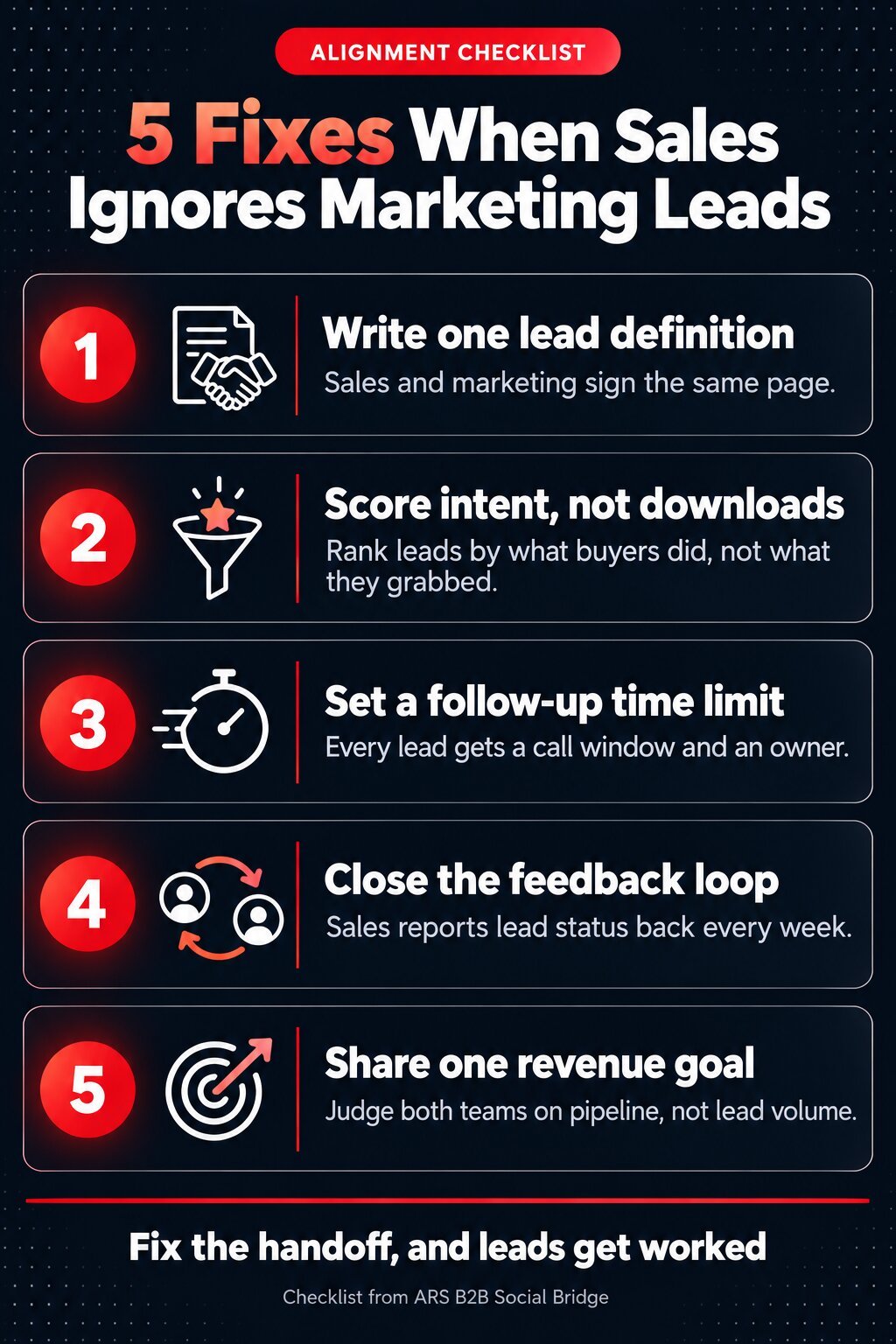
- Write one lead definition and have both team leads sign it.
- Score leads on intent, and show the reason next to every lead.
- Set first-touch targets by intent level, with alerts for missed leads.
- Require a status and a reason on every lead within a set number of days.
- Share two numbers across teams: lead acceptance rate and pipeline created.
Sales ignoring marketing leads is a solvable problem once both teams work from the same page. ARS B2B Social Bridge builds its programs on that standard, and you can see how in the Qualified Buyer Framework and the ARS DataVerse methodology.
Want leads your sales team will actually call? See how ARS B2B Social Bridge screens buyers before delivery.
See the Qualified Buyer Framework