

Content syndication looks like the cheapest way to fill a B2B pipeline. You pay $40 to $100 for a lead, per Foundry CRO, and leads start arriving quickly. Then your sales team picks up the phone.
Some contacts are already in your CRM. Others never asked to hear from a vendor. A few sit in the wrong job function entirely. This guide from ARS B2B Social Bridge walks through the seven costs that never appear on the invoice, with named benchmarks, a cost-per-opportunity formula and a checklist for your next contract.
Figures come from Foundry CRO, Implisit (published by Salesforce), LeanData and Demand Gen Report. Most benchmarks in this guide come from vendor and agency publications, so read them as directional.
What is content syndication, and why does it look cheap?
Content syndication means paying a publisher network to promote your gated asset, such as a report or whitepaper, and deliver the contact details of everyone who downloads it. It looks cheap because the invoice shows a low cost per lead. The real costs show up later, in CRM clean-up, sales time and compliance work.
Per Foundry CRO, content syndication averages $40 to $100 per lead, while the average B2B lead costs about $237 across all channels. On a spreadsheet, that looks like an easy yes. Foundry adds a catch: quality is generally lower, because the reader grabbed the asset from a third-party site instead of seeking out your brand.
Budgets scale fast. Revnew reports that syndication programs in B2B marketing routinely run $10,000 to $50,000 a month or more. At that spend, small leaks get expensive. Early-stage teams weighing that spend against runway can start with The Business Perspective's guide to raising seed funding for startups.
Our view at ARS B2B Social Bridge is simple: the invoice is where the cost starts, not where it ends. The seven costs below are the ones worth checking before you sign anything.
What do duplicate contacts and low-intent downloads cost in content syndication?
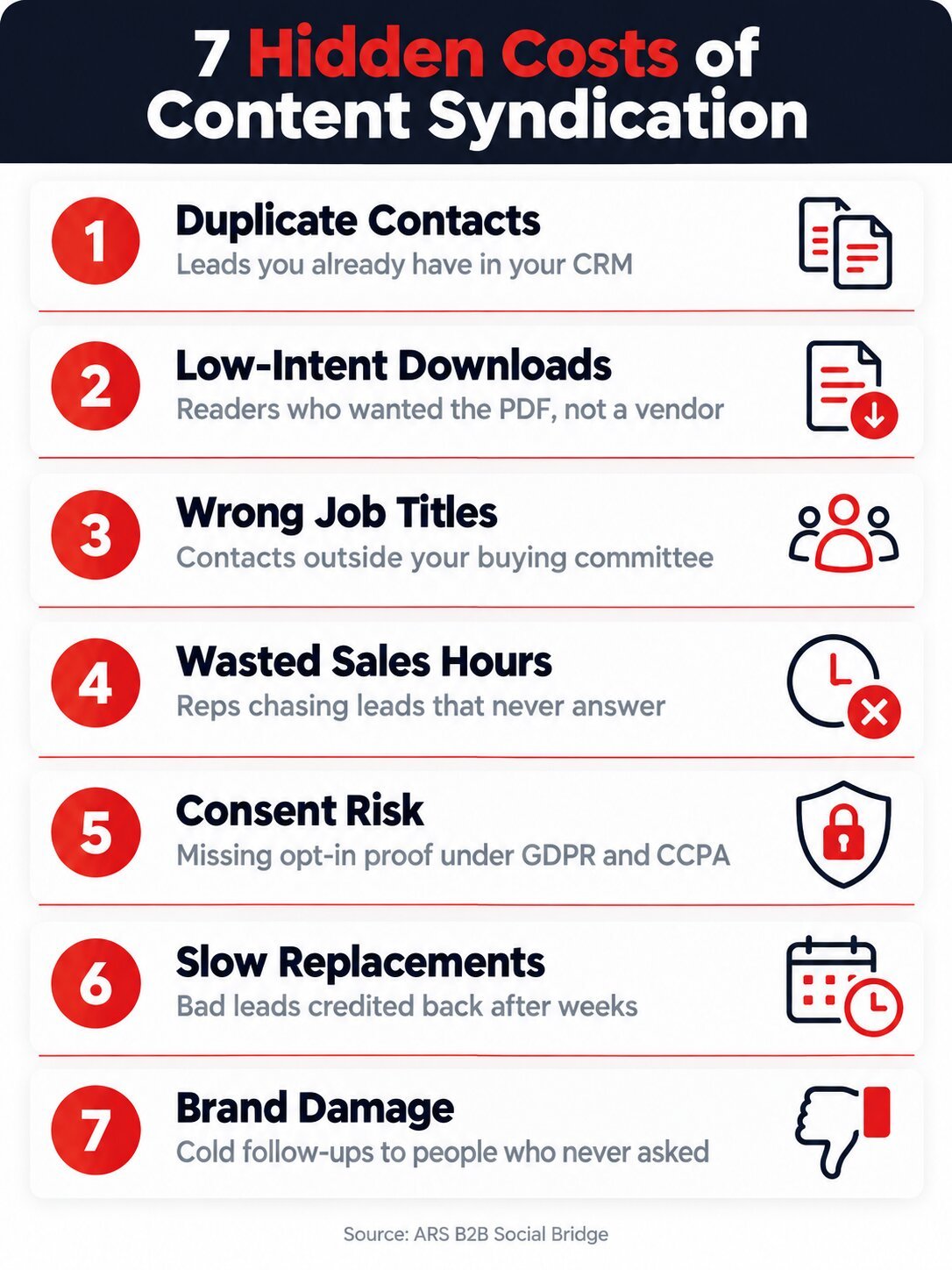
Duplicate contacts make you pay for people already in your CRM. Low-intent downloads fill your pipeline with readers who wanted the PDF, not a vendor. Both inflate the cost of each lead that matters, because the invoice counts them as delivered while your sales team counts neither as pipeline.
Cost 1: Duplicate contacts
Revnew's pricing guide points out that some networks sell the same lead to several buyers at once. Octave's guide for GTM teams lists the duplicate rate as a core quality check: how many delivered leads were already in your CRM. You pay full price for a name your team already owns, and a cold email to an existing prospect can do harm.
Cost 2: Low-intent downloads
Pipeline Road calls syndicated leads notoriously low-intent: people who downloaded a piece of content, not people ready to buy. Its advice is to treat them as awareness-stage contacts and score them on how they engage with your nurture emails, not on the first download. Hand them straight to an SDR for a cold call, and teams tend to blame the channel for what is really a process problem.
Prospeo reports that 48% of B2B marketers name lead quality, not lead quantity, as their top syndication challenge. The problem is common, and it starts with what you measure. For a sense of the gated B2B tech content people actually download, browse IoT Insights Hub.
How do wrong job titles and wasted sales hours drain a syndication budget?
A contact in the wrong job function can't sign off on your deal, and a rep chasing a silent lead loses hours that belong to real buyers. Both costs hide inside your payroll, not your syndication invoice, so most teams never attribute them to the campaign that created them.
Cost 3: Wrong job titles
A contact outside your buying committee is a lead that can't buy, even when the company is a perfect fit. Digital Nexa advises asking how a partner validates leads, including duplicate removal, email verification and job-title checks. Revnew adds that vendors apply different standards for what counts as a qualifying engagement, so get the standard in writing.
Cost 4: Wasted sales hours
Here is where the money leaves quietly. LeanData cites an average B2B lead response time of 42 hours, and an MQL-to-SQL rate of 13% to 21% per Forrester and other benchmark reports. Implisit's older analysis, published by Salesforce, found that across channels only 13% of leads become opportunities, and the average conversion takes 84 days.
Now picture a rep working a batch of cold syndicated contacts. Every call to a silent lead is an hour taken from someone who might actually buy. Lean teams feel this most, which is why Rise of Startups keeps coming back to focus and spend discipline for early teams.
Why is consent risk the content syndication cost most buyers miss?
Consent risk is the cost of holding contact data without proof the person agreed to hear from you. GDPR and CCPA cover the email addresses collected through gated downloads, and Forrester has noted that syndication partners share liability. A missing consent record puts every lead on that list in doubt.
Cost 5: Consent risk
Forrester warned when GDPR arrived that partners involved in content production, syndication and amplification share liability for compliance. Revnew's privacy guide makes the same point: GDPR and CCPA govern how email addresses and contact details are collected, processed and used. A vendor's promise isn't proof, so ask to see the consent record for the leads you receive.
The stakes are real. Demand Gen Report documented that Iron Mountain kept only 8% of its European database active after its GDPR compliance steps. A contact list you can't legally use is worth nothing.
Madison Logic CEO Keith Turco told Demand Gen Report in October 2024 that syndication providers have long operated like a black box, with little visibility into content placement. Marketers, he argued, should demand more. We agree. ARS B2B Social Bridge sets out its approach in its EU GDPR policy.
What do slow lead replacements and brand damage cost in content syndication?
Slow replacements mean you pay for bounced or disconnected contacts because nobody rejected them in time. Brand damage comes from cold follow-ups to people who never asked for them. One drains budget directly, the other drains trust you spent years building, and neither appears as a line item on the invoice.
Cost 6: Slow replacements
Prospeo's playbook says to shift the KPI to cost per opportunity and to enforce lead-rejection policies for bounces and disconnected numbers. That only works if your contract has a rejection window and your team checks inside it. At ARS B2B Social Bridge we built a postback system for lead status updates, so buyers can report back on each lead without chasing email threads.
Cost 7: Brand damage
Integrate lists brand reputation risk among the core syndication problems, because poor data leads to off-message outreach that erodes trust. Coredna's glossary describes a familiar complaint from sales: leads who don't remember engaging at all. A prospect who never asked to hear from you and then gets a three-email sequence will remember your name, just not kindly.
How do you calculate the true cost of content syndication?
True cost per opportunity equals cost per lead, multiplied by the number of leads needed to create one opportunity, multiplied by one plus your bounce rate. A $60 lead, four leads per opportunity and a 10% bounce rate give $264 per opportunity, not $60. The numbers are illustrative; the formula comes from Prospeo.
Prospeo's formula is the cleanest way to see through the invoice: cost per lead x leads per opportunity x (1 + bounce rate) = true cost per opportunity. Sotros Infotech runs a similar exercise from the sales side. Its worked example assumes a 4% lead-to-SQL rate, so a $50 lead works out to $1,250 per SQL ($50 / 0.04).
Revnew warns that tracking leads delivered and cost per lead alone hides the real story. Its benchmark for well-targeted programs is a lead-to-MQL rate of 12% to 28%. If your numbers sit far below that range, the problem is probably targeting or validation, not volume.
| # | Hidden cost | Where it shows up | What to ask the vendor |
|---|---|---|---|
| 1 | Duplicate contacts | CRM and invoice | Duplicate suppression against your CRM before delivery |
| 2 | Low-intent downloads | Low reply and meeting rates | Evidence of intent beyond one download |
| 3 | Wrong job titles | Leads outside the buying committee | Written job-title and seniority validation |
| 4 | Wasted sales hours | Rep payroll | A fast follow-up plan and scoring rules |
| 5 | Consent risk | Legal and compliance exposure | Proof of consent for each lead |
| 6 | Slow replacements | Bounced and disconnected contacts | A rejection window long enough to test the data |
| 7 | Brand damage | Prospect trust | An approved outreach sequence for syndicated leads |
| Cost per lead | Leads per opportunity | Bounce rate | True cost per opportunity |
|---|---|---|---|
| $40 | 4 | 10% | $176 |
| $60 | 4 | 10% | $264 |
| $100 | 6 | 15% | $690 |
Is content syndication still worth it, or are the critics right?
Critics say syndicated leads are cold, duplicated and expensive to qualify. Defenders say well-targeted programs still beat events on cost and produce real pipeline. The common ground: the outcome depends on targeting, validation and nurture, not on the channel itself. The problem is how most buyers run it.
Critics have a point. Pipeline Road's glossary warns that anyone expecting hot leads from syndication will be disappointed. And Sotros Infotech argues the channel needs an average contract value of $15,000 or more to produce positive ROI once nurture, SDR time and lead processing are counted.
Defenders have data too. Foundry CRO puts in-person events at roughly $811 per lead, far above syndication's $40 to $100. A marketing leader quoted by Demand Gen Report said sales-ready conversion for syndicated leads held at 22% for a year after the team honed its approach and handled consent properly.
Our take at ARS B2B Social Bridge: the channel isn't the problem. Untested vendors, loose targeting and no validation are. Treat content syndication as a pipeline source you audit, not a lead tap you open.
What do B2B buyers ask most about content syndication?
Buyers mostly ask about price per lead, conversion rates, compliance, lead quality, measurement and fit. The six answers below use named benchmarks, and most come from vendor and agency studies, so treat them as directional before you plan a budget.
How much does content syndication cost per lead?
Foundry CRO puts content syndication at $40 to $100 per lead. Sotros Infotech quotes $25 to $80 for basic contact-level MQLs and $150 to $400 for intent-qualified, BANT-verified leads. Price rises with tighter targeting, so compare vendors on cost per opportunity, not on the headline cost per lead.
What is a good lead-to-MQL rate for content syndication?
Revnew puts lead-to-MQL rates at 12% to 28% for well-targeted programs. LeanData, citing Forrester and other benchmark reports, places the average MQL-to-SQL rate between 13% and 21%. If your rates fall well below those ranges, check targeting and lead validation before you blame the content itself.
Are content syndication leads GDPR compliant?
Not automatically. Forrester noted that partners involved in syndication share GDPR liability, and CCPA also covers contact data. Ask each vendor for proof of consent per lead, not a general assurance. Madison Logic's CEO told Demand Gen Report that providers have historically been opaque about placement and practices.
Why do content syndication leads convert poorly?
Most contacts downloaded an asset on a third-party site and never sought out your brand, per Foundry CRO. Pipeline Road describes these leads as low-intent and advises treating them as awareness-stage contacts. Direct SDR cold calls on the first download usually underperform, so nurture and scoring matter more.
How do you measure content syndication ROI?
Track cost per opportunity, not cost per lead. Prospeo's formula multiplies cost per lead by leads per opportunity and by one plus the bounce rate. Revnew warns that reporting only leads delivered and cost per lead hides real performance, so segment results by campaign, asset and lead source.
When does content syndication make sense?
It fits when the average contract value is high and the buying committee is well defined. Sotros Infotech suggests a minimum of about $15,000 in contract value for positive ROI. It also needs tight targeting, intent signals, lead validation and a nurture plan, or the savings per lead disappear.
What should B2B buyers do before signing a content syndication deal?
Before signing, ask every vendor for seven things: duplicate suppression, intent evidence, job-title validation, a follow-up plan, proof of consent, a rejection-and-replacement window and an approved outreach sequence. Then measure cost per opportunity, not cost per lead. That one change shows whether content syndication is working.
- Duplicate suppression: match every delivered lead against your CRM.
- Intent evidence: ask what the reader did beyond a single download.
- Job-title validation: get the standard in writing.
- A follow-up plan: decide who calls, how fast and with what message.
- Proof of consent: request the record, not the promise.
- A rejection-and-replacement window: long enough to test bounces.
- An approved outreach sequence: no cold email blasts to downloaders.
Content syndication still earns a place in a B2B plan. It earns it when buyers measure cost per opportunity and demand clean, consented data. ARS B2B Social Bridge builds its lead programs around that standard, and you can see how in the Qualified Buyer Framework and the ARS DataVerse methodology.
Want leads that pass these seven checks? See how ARS B2B Social Bridge screens buyers before delivery.
See the Qualified Buyer Framework